Skip to content
Jason A. Heppler

Microblog

Microblog

John Lewis Dies at 80

Tamar Hallerman in the Atlanta Journal-Constitution:

In June 1963, [John Lewis] moved to Atlanta, the headquarters of SNCC, taking up residence in a sparse second-floor walk-up in the southwest corner of the city. He had barely unpacked his bags before he and other civil rights leaders were invited to White House. President John F. Kennedy, who would be assassinated a few months later, had concerns about the impending march.

The peaceful event drew more than 200,000 people to the National Mall, all pushing for more federal attention to the electoral, social and economic plight of African Americans. That muggy August day lives on in America’s collective memory as the day King articulated his dream for an equal society. But Lewis, then 23, delivered the event’s most controversial address, rife with frustration and anger at the “cheap politicians” whose inaction perpetuated inequality. The Kennedy administration and march leaders implored him to soften the speech at the eleventh hour.

“To those who have said, ‘Be patient and wait,’ we must say that ‘patience is a dirty and nasty word,’” Lewis stated in his original speech. “We cannot be patient, we do not want to be free gradually. We want our freedom, and we want it now.”

The crowd’s applause interrupted Lewis 14 times.

Barack Obama:

I first met John when I was in law school, and I told him then that he was one of my heroes. Years later, when I was elected a U.S. Senator, I told him that I stood on his shoulders. When I was elected President of the United States, I hugged him on the inauguration stand before I was sworn in and told him I was only there because of the sacrifices he made. And through all those years, he never stopped providing wisdom and encouragement to me and Michelle and our family. We will miss him dearly.

Personal

Moments

Today is day 44 since my family and I self-isolated at home. We have, for the most part, achieved some sort of normal in our household. Thankfully, our weather has been beautiful in the last week or so. We’ve taken the opportunity to eat meals in the backyard, work outside in the garden, or take walks around the neighborhood.

Through all of this, these small moments have been essential:

  • Taking walks around the neighborhood as a family in the evenings.
  • Clearing and simplifying my at-home workspace.
  • Coffee. Morning and afternoon.
  • Board games with the kids.
  • Daily exercise. The Peloton app and Fitbod have been essential for me.
  • Journaling in Day One.
  • Impromptu phone calls or FaceTime with friends and family.
  • Continuing with my Norwegian language lessons.

As part of this, I also battened down the informational hatches: I’m spending almost no time on Twitter except for some of the Twitter lists I follow. Apple News gets checked once a day, but is otherwise not on my home screens nor is it allowed to send me notifications. I didn’t do this early on, and the never-ending flow of news on COVID-19 was too much. I also think it’s worth seeking out media that give you joy. (Parks and Rec’s S4E11 “The Comeback Kid” is perfect television.)

Personal

BootcampR

This semester I am piloting a new six-week workshop series on the R programming language called BootcampR.

I’ve been teaching R workshops for a few years now and I’ve seen a few things that keep recurring in these. First, I seem to run out of time. Every time. So, the easy fix is to make the workshop a little longer – of course, I want to be respectful of people’s schedules, so I didn’t add much time to the workshops. But expanding from one hour to an hour-and-a-half might help make these workshops a bit more managable.

One thing that does work well is the hands-on component of the workshops. When I co-taught my first R workshop at the Digital Humanities Summer Institute a few years ago with Lincoln, we developed RMarkdown worksheets as a way to interactively work through the language together with the class. I’ve continued to develop these worksheets, and I think overall it works pretty well for getting people hands-on with the language in addition to including additional information and explanation about why they’re doing certain things with the language.

For a while now I’ve been teaching the tidyverse to R novices, but I’m trying something new this year: in the first two workshops, all of the work we’re doing is happening in Base R. In week three, we’ll start learning the tidyverse – and what I’m hoping to achieve here is a strong contrast between Base R Ways™ and Tidyverse Ways™ of doing the same task. My goal here is two-fold: to reiterate that there are multiple ways to do the same task in programming, and to show that there’s a cleaner and easier way of doing the task instead of using Base R. This is the highly opinionated section of the workshop: I remain convinced that the way to work with R is by using tidyverse methods.

Finally, the last thing the workshop series is trying to do is build upon itself. In previous workshops, I’ve had to cram in a lot of information: an intro to R, to RStudio, and to the Tidyverse is a lot to fit into one hour. I’ve now broken out the intro to R material into its own workshop, which means by the time we get to class for the Tidyverse I can spend a lot more time explaining how the methods work and why you’d want to use them.

All of the content I’m creating for the course is released CC-BY, so please feel free to use anything I’m creating. Included for each workshop are readings (to be completed before the workshop, so we’re all coming at this with some prior knowledge), an interactive worksheet, resources for after the workshop to keep practicing or read more explanation, and slides from the lecture portion.

It’s the pilot version of this series and I’ll be assessing how it all went at the end. But so far, it seems to be going smoothly.

Programming

Email

Email is kind of amazing. Lots of us slag on it, and I’m quick to admit I’m happy as a Slack user or Basecamp user who appreciates the chance to cut down on the amount of work email I receive. But I also get lots of great stuff, like newsletters (from Anne, Lincoln, Alan, Dan).1 The best of that email are those who encounter my work.

One of my absolute favorite things about being a digital historian is how public it is – we’re not just writing things for other people in academia, we’re producing work that’s intentionally public-facing and invites engagement. And that engagement happens all the time. As a writer, that is thrilling.

It’s hard to express just how powerful it is to have someone drop you a note, explaining that your little history project on the Internet about Buffalo Bill Cody and his hiring of Native Americans for the Wild West expeditions caught their attention. To get a note from someone whose grandfather was once part of the Wild West expedition, and asking if I had more information about them. To get a note from a high school student telling me they appreciate me sharing some work openly. To hear from college students that find a project enlightening for thinking about a historical process. To be invited to participate in related projects or new initiatives.

All because I made something for the Internet. All because I included an easy way to reach me by email.


  1. Maybe it’s a confirmation bias, but I think there’s something to be said about how newletters have seeming taken the place of blogging. ↩︎

Tech life

Democratic Typography

Between March 2019 and today (2/10/2020), we’ve had twenty-eight candidates for the Democratic nomination in the United States. I went through candidate websites and grabbed their primary logo, which I mostly find fascinating to see the moods that are conveyed by color and typography.1

By design alone, I think Buttigieg, Beto, and Castro have strong, memorable designs. Bennet and Buttigieg share similar vibes, Sanders’s is a classic, Inslee’s is somewhat forgettable (his later one was much better).


  1. I’ll try and keep this updated if anyone else enters the race. ↩︎

Personal

Omaha Zoning

A few days ago the New York Times Upshot ran a piece on single-family zoning and the emergence of political energy that is seeking to curtail the prevalence of single-family zoning. We see this happening in Oregon, California, and Minneapolis in particular as cities try to confront affordability, climate change, and inequality.

I wanted to take a look at Omaha, and tried to generate a similar map. Pink represents single-family zoning, blue is multifamily zoning.

Omaha zoning.

The housing units here fall into what Omaha zones as Rn residential that varies from high density to low density, as well as what Omaha calls “urban family residential” which includes single-family housing, duplexes, and townhouses. While Omaha allows for additional housing in areas not necessarily zoned for residences (such as apartments built over offices), the map looks only at land set aside exclusively for housing.

The higher resolution version is here. Thanks to the City of Omaha for providing open datasets for building footprints, zoning, and city limits.

Place

Alan Brinkley, RIP

What most clearly characterized the intellectual landscape of the first years of the New Deal was an exceptionally wide range of approaches to reform. Some were rooted in the progressive philosophies of the first decades of the 20th century, others in the experience of World War I, still others in the generally unsuccessful reform initiatives of the 1920s. . . . In fact, the early New Deal was awash in ideas—ideas of significant range and diversity (at least by American standards), but ones that somehow managed for a time to coexist.

– Alan Brinkley, The End of Reform (1995)

Alan Brinkley died over the weekend. He was a giant in writing the history of twentieth century America, and his End of Reform is nothing short of masterful. Rest in peace.

Academia

Making my Budget Peloton

If you’re a podcast listener or friend of the pod, you’ve likely heard the advertisements for Peloton – the high-end, at-home bike trainer designed to give you a spinning class experience from your home. But at $2,000 for their bikes, it’s a high ask to get the equipment needed for the full Peloton experience.

So I went in search of a budget-friendlier route. Here’s some notes about my setup.1

I love bicycling, and have racked up plenty of miles with my Trek. But Nebraska winters can be brutal (have I mentioned lately I miss California?) and, with a young kid in the house, it can be hard to find time to get out and ride. So a stationary bike was a perfect solution for me.

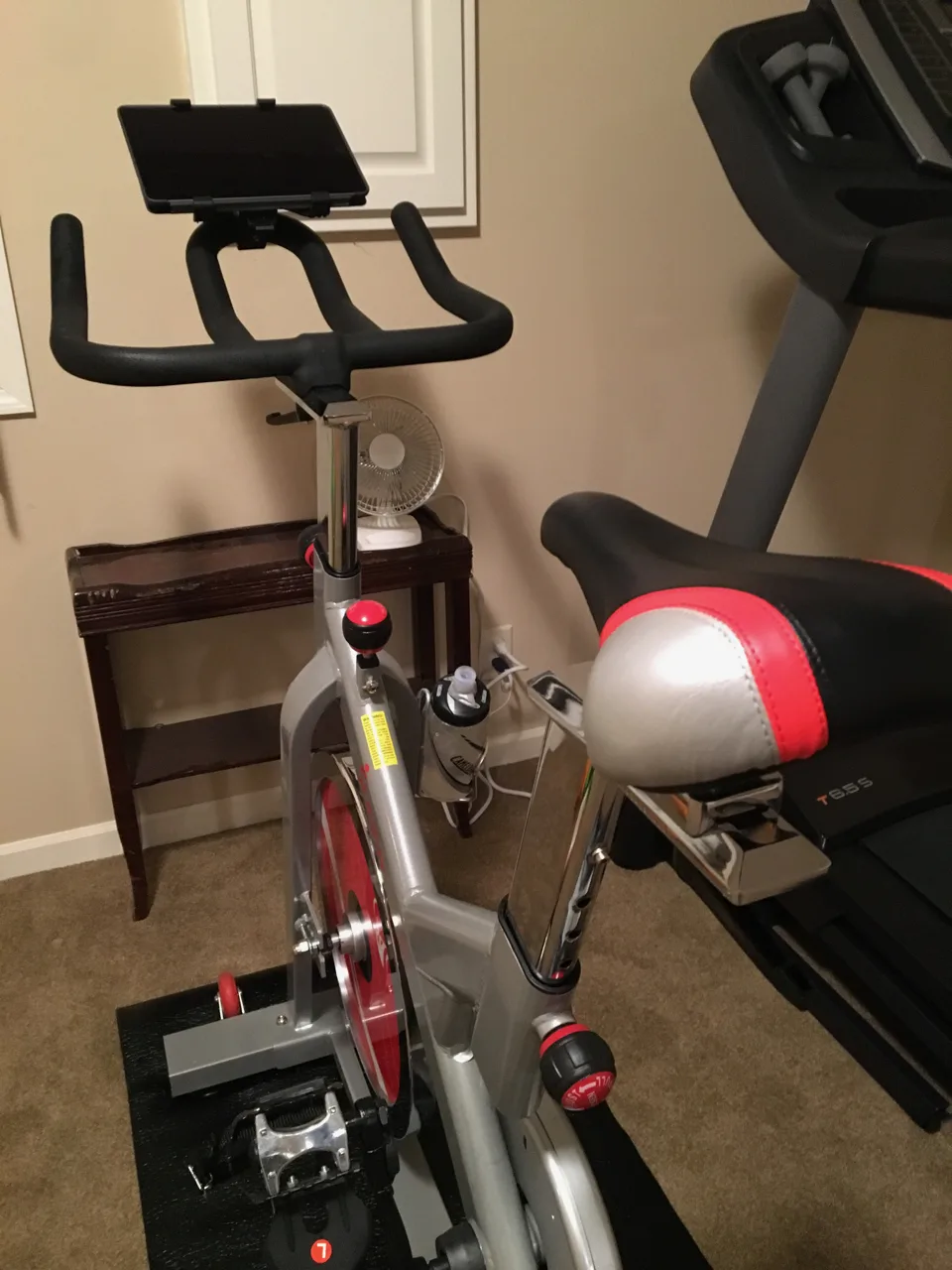
My bike setup.

The bike. Sunny Health makes great indoor spinning bikes, and I went with this $264 one. It’s heavy and takes a bit of work if you’re, say, carrying it to your basement. But it’s not difficult put together (so, skip the Amazon professional installation) and it does the job wonderfully. It’s sturdy (a good thing, because you’ll really be cranking the pedals) as well as quiet. You won’t have to worry about waking your kids while they’re asleep and you’re pedaling your ass off.

The cadence. Next, pick up a Wahoo wireless RPM cadence monitor and attach it to your crank shaft. You’ll need this to monitor your cadence during rides, which is important for keeping pace with the instructor. I typically sync this data to Strava. UPDATE: Not anymore. I just record the workout with my Apple Watch and keep everything in Apple Health.

The trainers. Finally, subscribe to the Peloton app – anyone can buy and use the app, you don’t need their equipment for it. And their instructors are great – you can filter classes by instructors, length, type of workout, and so on to really nail down what you’re after. I have an iPad mount attached to the handlebars to hold my iPad with the app while I ride, as well as a mount for my phone to monitor cadence. There’s a free two-week trial if you want to test it out.

All in all, it’s a fraction of the cost of a Peloton setup. The integration won’t be as fully-featured – you won’t, for example, be able to monitor distance – but all the data you capture can sync to Apple Health without a hitch.

Some tips

  • Find an instructor you like. Robin and Emma are awesome.
  • Don’t jump into the long rides or hard rides, especially if you’re just starting out. Pick a 30 minute ride and build up from there.
  • Monitor your heartrate. I have an Apple Watch for this.
  • Don’t go crazy buying peripherals. Sure, you could get cycling shoes or clips – but you don’t need them. The only peripheral items I’ve picked up are a cheap iPad and iPhone mount and a rubber mat to protect the floor under the bike.

  1. Of course, the budget-friendliness of this setup also means I already have the additional equipment needed. In this case: an iPhone, an iPad, and an Apple Watch. Don’t follow this guide if you need to buy Apple devices to make it work; just go buy the Peloton. ↩︎

Personal

Overcast 4.2

Marco Arment introducing Overcast 4.2:

In Overcast 4.2, the login screen now prominently encourages anonymous accounts by default.

If you already have an account in iCloud, it’ll pop up a dialog box over this screen asking if you want to use it.

And the first time you launch 4.2, people with email-based accounts will be encouraged to migrate them to anonymous accounts.

How often do you get an update to an app that asks for less information from you? I’ve been an Overcast user since it launched, and Marco’s commitment to this kind of thing adds to my desire to keep supporting his work for a long time.

Tech life

Newsletter

Occasional writing on the American West, agricultural history, and political culture.