Skip to content
Jason A. Heppler

Microblog

Microblog

Yearly Theme

I’ve been thinking over things I want to focus on during 2023 and coming up with a few names for what I might call this. There are some high-level things I’m capturing: health, wrapping up my book to get on to the next project, planning and career stuff over the next five years, more focus on writing, pursuing some newer interests (or, reading widely and deeply as possible in certain areas), and building on learning I’ve been doing for a few years (for example, going beyond what Duolingo can do for me in learning Norwegian).

Last year was the Year of Lagom: a Swedish word meaning “just enough” that evokes ideas of “moderation,” “in balance,” and “suitable.” I feel like I did pretty well this year. So, I’ve been toying with the following labels for this year:

  • Year of Release
  • Year of Learning
  • Year of Less
  • Year of Festina Lente (I’m currently leaning heavily towards this one.)
  • Year of Momentum

Lagom will continue to be a big part of my life and approach to things, but I like taking the moment during this time of year to think about what’s next. Festina Lente may just be it.
Personal

Updating My RSS

I’ve made a few changes to the RSS feeds around the site that I thought worth documenting, especially if you primarily read anything here via an RSS reader. There are now three feeds you can subscribe to depending on the content you want:

  • The full feed: This has everything, from posts to book logging to link posts. If you want the full garden hose, this is the one to subscribe to. This will likely always remain the primary feed even if I decide to discontinue separate feeds or move to a different blogging platform in the future, if you feel like future-proofing your RSS feeds.
  • The books feed: This is only updates to my reading log. I suspect few-to-none will subscribe to just the book log, but it’s there if you want it.
  • The blog feed: This has blog posts and link posts. If you don’t care about the book log, this is the feed for you.

And as always, there’s the micro.blog feed.

Adjust accordingly.

Tech life

The Agency of Ice

Jen Rose Smith, on her new book-in-progress:

… as a substance, ice has agency and it is an entity that moves and shapes and responds to the world. We don’t just act upon ice, ice is also making decisions of its own accord. In that sense, I’m thinking about what ice does offer, just by virtue of existing in all of its movements, shapes, and conditions, to thinkers, intellectuals, scholars, etc. for thinking about relations of power. I’m interested in critical analyses of race, and indigeneity, thinking about these constant struggles over territory and sovereignty, especially again, as ice is changing shape and moving, particularly in Arctic spaces. And thinking of that, in this final prong, I’m interested in how ice then complicates these questions of boundaries and borders. Ice is pushing out these neat containers, of land, of ocean, of the concept of roots and tides, as it moves and offers these different ways of organizing the world.

There’s a line in Bathsheba Demuth’s book where she mentions that in the face of climate change people of the Arctic will never again feel cold like they have in the past. It’s an arresting and tragic line, and has me thinking about cold and ice a lot these days.

Environmental history

New Avenues

Robin Sloan:

For people who care about creating worlds together, rather than getting rich, the web is the past and the web is the future. What incredible luck, that this open, decentralized “way of relating” claimed a position at the heart of the internet, and stuck fast.

Indie web

Running my Reading Log

At various moments I’ve recorded my reading habits using LibraryThing and then Goodreads. I’m not particularly good at making sure everything gets recorded (especially since, as a scholar, I also dig into portions of books that I’m not sure really rise to the level of “I’ve read this”). But I do like keeping this log of information, but I’m less keen to feed that information to Amazon or Google.

Some time ago I started playing around with keeping my own reading log. I don’t tend to include much in this log like reading notes or ratings, but it is nice to have the list of things I’ve read over the course of a year. Sadly I missed this IndieWeb pop-up back in February about distributed libraries, but as I’ve said before I’m a big supporter of the IndieWeb’s vision for the web: of owning your little parcel of digital space and taking ideas, values, and people seriously.

So, my reading log is more a feed of things I read rather than a space for reviews or notes (those find themselves in Obsidian). Does anyone find that interesting? I suppose some might. (Don’t worry if you don’t, the book log isn’t included in the main RSS feed – there’s now a separate RSS feed for just books).

But at some point over the summer I stopped logging books here – mainly because of the friction of getting book metadata by hand, but also because micro.blog’s book search was so good and easy to use. I still use micro.blog’s bookshelves a lot, but I also want to include that content here. So I needed to solve the friction of adding books to the log. I think I’ve come up with a reasonable way forward.

The solution was this node script that asks for an ISBN or book title, fetches the data from the Google Books API, and writes a new markdown file with the appropriate metadata all in place for me. Much less friction, easier to manage, and exists here on my space on the web.

It’s not an indie version of Goodreads, but a simpler thing. And that’s enough.

Tech life

Web People

Meg Hourihan, writing in 2000:

And I realized there are dot-com people and there are web people. Dot-com people work for start-ups injected with large Silicon Valley coin, they have options, they talk options, they dream options. They have IPOs. They’re richer after four months of “web” work than many web people who’ve been doing it since the beginning. They don’t have personal sites. They don’t want personal sites. They don’t get personal sites. They don’t get personal. Web people can tell you the first site they ever saw, they can tell you the moment they knew: This, This Is It, I Will Do This. And they pour themselves into the web, with stories, with designs, with pictures. They create things worth looking at, worth reading, worth coveting, worth envying, worth loving. They create Beautiful Things. We need more of those.

Indie web

0 Tweets

Tonight I wrote a small Go script to delete all of my tweets. There isn’t much to say about this except that Twitter has always been an ephemeral presence for me — I’ve had a somewhat long-standing practice of deleting everything older than three years back (and of syncing tweets to a Google spreadsheet so I still have a copy of everything).

But the truth is what I write here on my website is the historical record.

Twitter served a great purpose for me at one point in my career – as a place to share my work, learn about others, and connect with a community. But I feel like that has become less of a sure thing anymore. As I wrote yesterday, Twitter – and most social media – doesn’t feed what I want to focus on: thinking, writing, making.

So, the tweets are at 0. Here’s how I did it:

package main

import (
	"fmt"
	"log"
	"strconv"

	"github.com/ChimeraCoder/anaconda"
)

func main() {
	// Set up the Twitter API
	api := anaconda.NewTwitterApiWithCredentials(
		"",      // Access Token
		"",      // Access Token Secret
		"",      // API Key
		"",      // API Secret
	)

    // Continue to fetch the timeline and delete tweets until there are no more tweets to delete
	for {
		// Fetch the timeline
		timeline, err := api.GetUserTimeline(nil)
		if err != nil {
			log.Fatal(err)
		}

		// If there are no tweets to delete, then we are done
		if len(timeline) == 0 {
			break
		}

		// Delete all of the tweets
		for _, tweet := range timeline {
			// Delete the tweet
			_, err := api.DeleteTweet(tweet.Id, true)
			if err != nil {
				log.Fatal(err)
			}

			// Print the tweet that was deleted
			fmt.Println("Deleted tweet: " + strconv.FormatInt(tweet.Id, 10))
		}
	}
}

Indie web

Embracing the Limits

With Twitter’s impending demise I’m having some serious ideas about going full Knuth with social media, with the exception of here at micro.blog. Famously, the renowned computer scientist Donald Knuth does not use email:

I have been a happy man ever since January 1, 1990, when I no longer had an email address. I’d used email since about 1975, and it seems to me that 15 years of email is plenty for one lifetime.

Email is a wonderful thing for people whose role in life is to be on top of things. But not for me; my role is to be on the bottom of things. What I do takes long hours of studying and uninterruptible concentration. I try to learn certain areas of computer science exhaustively; then I try to digest that knowledge into a form that is accessible to people who don’t have time for such study.

I’ve been around Twitter since 2008. I’ve joined Mastodon, but at the moment I don’t feel like it’ll stick for me. And the community around micro.blog is so much nicer, calmer, thoughtful. As I wrote last year, I want to spend my already time-constrained days thinking and writing. Twitter and Mastodon don’t contribute to those things.

Maybe fourteen years of social media is enough for one lifetime.

Personal

Thinking on the Collapse of Twitter

Robin Sloan on his proposed protocol, Spring ‘83:

You feel it, don’t you? They’re all crumbling, the platforms of the last decade. It’s unsettling, but/and also undeniably exciting. Tall trees fall in the forest, and light streams in, nourishing places it hasn’t reached in ages.

But we, as users of the global internet, cannot just ride the same rollercoaster again. It’s too embarrassing to be trapped inside these hungry corporate gambits, these dumb proper nouns. The nouns and verbs of our online relationships should be lowercase, the way “magazine” is lowercase, the way “movie” is lowercase. Anybody can make a movie. Anybody can try.

I’m more or less off Twitter these days—and even moreso under the new management—in favor of places like micro.blog and Mastodon. But here we stand, at the edge of a better web, a new platform, a new protocol. And that’s exciting.

Indie web

Developer Notes: A quick and dirty text diff

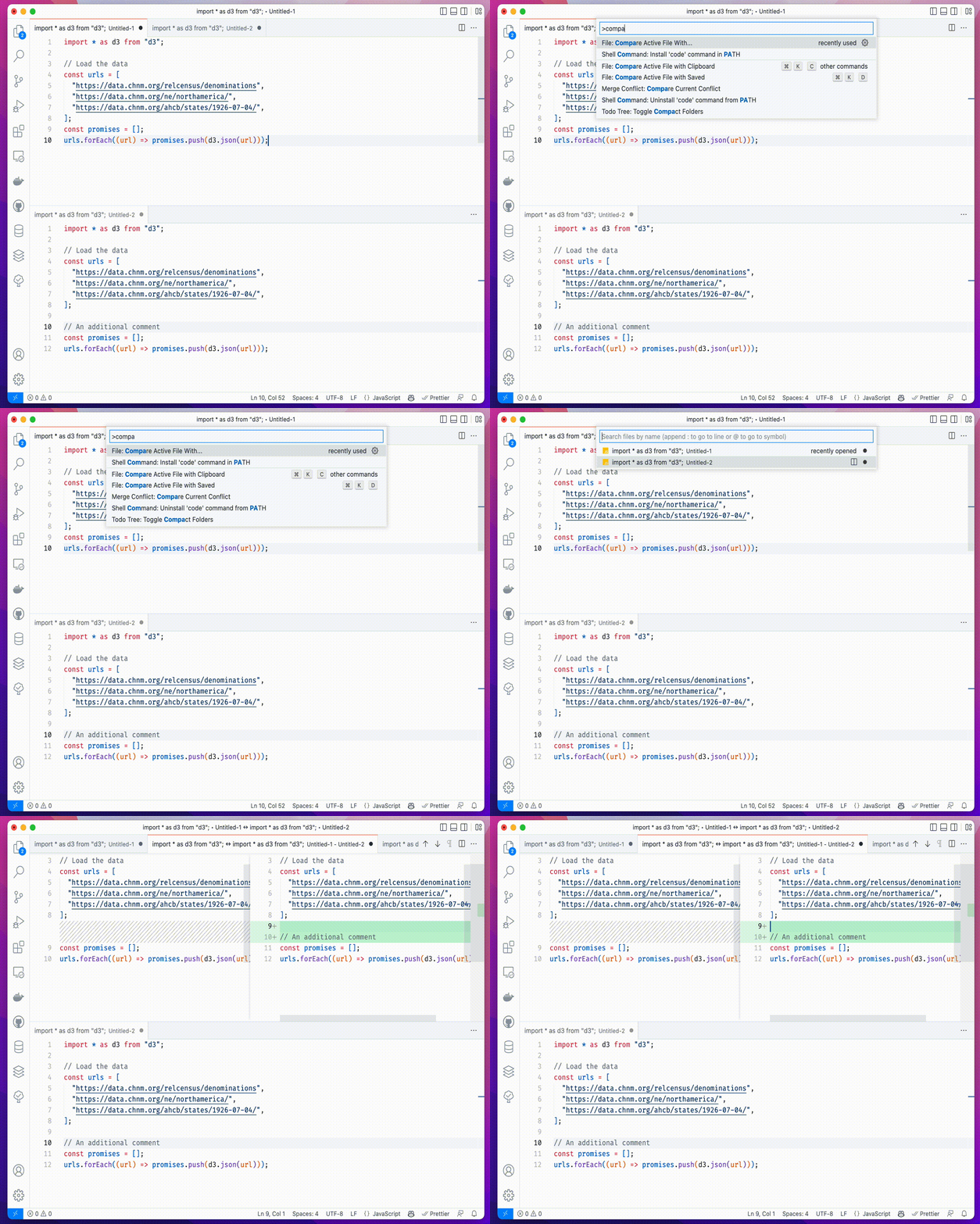
Sometimes it can be useful to do a quick comparison of text—whether that’s code, prose, or otherwise—and several ways to tackle the task. There are some online tools to do this, as well as command line tools (like the built-in diff tool or even vim -d file1.txt file2.txt). But it turns out, you can do this with VSCode without the need of an extension, even.

  1. Copy/paste to untitled document 1
  2. Copy/paste to untitled document 2
  3. Make sure your cursor is in the document you want to compare.
  4. CMD + Shift + P and select “Compare active file with…” and select document 2.

VSCode diff.

Programming

Newsletter

Occasional writing on the American West, agricultural history, and political culture.