Microblog
Microblog
Indulge in Curiosity
“I’m a big believer in boredom,” [Steve Jobs] told me. Boredom allows one to indulge in curiosity, he explained, and “out of curiosity comes everything.” The man who popularized personal computers and smartphones — machines that would draw our attention like a flame attracts gnats — worried about the future of boredom. “All the [technology] stuff is wonderful, but having nothing to do can be wonderful, too.”
Via Gina Trapani.
Mangling the Origins of the Early Internet
Timothy B. Lee of Ars Technica writes on a poorly researched piece by L. Gordon Crovitz in the Wall Street Journal, who maintains that government played little role in the early Internet. It’s certainly the case that the Internet as we know it today exists because of private sector development, but the private sector’s involvement in the Internet doesn’t come to fruition until around 1995. The technical origins and standards trace their roots to government-funded research. Thus is the nature of the mixed economy in the late twentieth century United States: government investment makes early research possible through prodigious funding, and private investment furthers development and brings the fruits of the research to the public. Lee offers plenty of useful corrections, including pointing out Crovitz’s misunderstandings of Internet technology, as does Michael Moyer at Scientific American.
UCI Study Finds People Who Check Email Less Frequently Have Better Focus
A new study by the University of California-Irvine finds that people who check email less frequently have better focus. Surprise!
What the Internet Looks Like
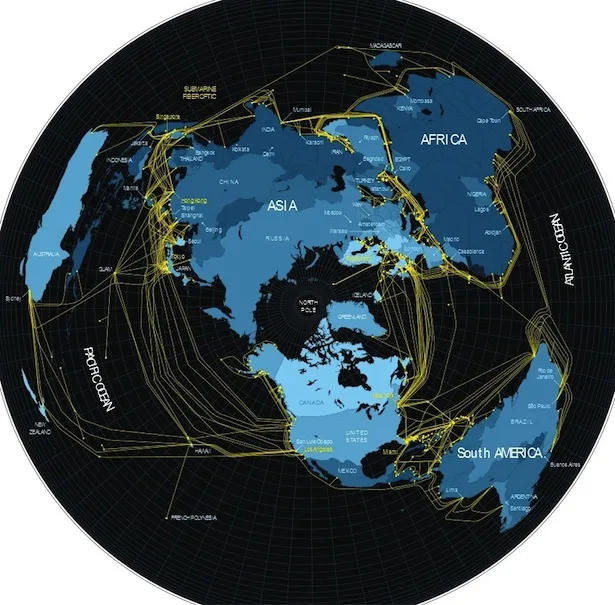
Here is what the Internet looks like: not a series of GIFs or a video of surfing goats, but a spindly collection of fiberoptic cables. The Internet, as a physical thing, actually looks a lot like a series of tubes.
The Vertue of the Coffee Drink
This is, quite possibly, the earliest known advertisement for coffee in England.
Digital History Training Becoming Common in Public History Programs
Steven Burg notes that digital history training is becoming more common among public history programs:
Almost two-thirds (64.5%) of the responding program directors reported that graduates of their programs would be leaving with competency in digital history and new media. Fifty-nine percent of public history program directors indicated that content on digital history and new media had been integrated into existing courses, and fully 46.2% stated that their programs had added one or more new courses on the study of new media or digital history. The directors also reported that more than one-third of public history programs are preparing their students to create or author digital history or new media resources (35.9%).
Writing for History Buffs
Alexandra Lord makes the case that for professional history to thrive, historians need to be mindful of writing accessibly for a wide audience:
If our profession is to thrive in or outside of the academy, we need to encourage and train new scholars to write accessibly. We also need to use new media to connect with the public. Fundamentally, we must provide more opportunities for graduate students to engage with the public, and we must better reward tenure-track and tenured faculty members for seeking to reach a general audience.
Advice I whole-heartedly agree with.
The Busy Trap
Tim Kreider writes about the importance of idleness not only to our creativity and productivity, but to our health:
Idleness is not just a vacation, an indulgence or a vice; it is as indispensable to the brain as vitamin D is to the body, and deprived of it we suffer a mental affliction as disfiguring as rickets. The space and quiet that idleness provides is a necessary condition for standing back from life and seeing it whole, for making unexpected connections and waiting for the wild summer lightning strikes of inspiration — it is, paradoxically, necessary to getting any work done.
Google Tracking Wildfires in the West
Ars Technica points to Google’s new platform for tracking the wildfires currently ravaging the American West. Google is pulling data from the US Geological Survey, InciWeb, the Red Cross, DigitalGlobe satellite information, and fire weather information from NOAA’s Storm Prediction Center and state-level emergency management to plot the fires in Google Earth and Google Maps